Saturday, October 9, 2010

Messenger Girl

1925
Cele's 8th grade class. Dad drew the arrow.
Dads always draw arrows on photos.

Cele told us that she quit school after eighth grade, a source of embarrassment to her.

She said she earned this set of classics in a spelling bee.
It's one of the few things of hers we still have.
The chrome dog bookend is also hers. I've lost the other.


AT&T Building at 195 Broadway

The story we heard about her leaving school was that she accompanied a friend to a job interview and she got the job instead of the friend. Because the family needed the money (this would be about 1925) she took the job at the American Telephone and Telegraph Company and commuted from Brooklyn to Manhattan.


Most remarkably the job description involved roller skates. She delivered the mail on skates.

I remember Ben telling us he noticed her whizzing around the floor (he was about 17 or 18, she 16 or 17) and here we are....*

Rollerskaters in California, the '40s

Like so many of the other stories we can’t corroborate, this one always seemed a bit dubious. We’d heard of roller-skating carhops but mail girls on skates was a little farfetched.

Messenger girls on skates

I looked around on the internet , however, and found a few memoirs mentioning a job category called a messenger girl. It was an entry level job, one of the few thought appropriate for females.

Here's a job description from an employment manual:
Messenger girls at Douglas Aircraft in the early 1940s
"The messenger girl, as her name implies, carries messages from one part of the store to another and runs errands for nearly all persons on her floor, for example, when a check is to be signed, orders are to be certified, or a transfer is to be carried to another department....The nature of the work depends upon the arrangement of the store and the mechanical devices in operation."

In a memoir a woman named Helen Grottola remembered working as a messenger girl in the same building that Cele did:

"My sister and I both worked at AT&T in New York at 195 Broadway as messenger girls. We made fifteen dollars a week and we paid three dollars and fifty cents a week for commuting to the city. We were just surviving..."

195 Broadway Today
Skates were apparently optional.
 It wasn't a good job, but it was a job. I imagine she moved on to better paying jobs before she quit AT&T in the 1940s to have a family. It's hard to remember how few options there were for women---or 14 year old girls.

Cele (second from left) and some of her friends,
 possibly friends she worked with at 195 Broadway, in 1929

*Jane recalls Ben telling her that he noticed Cele in an AT&T talent show strumming the ukulele. Both memories could be right. She was noticeable.

Saturday, October 2, 2010

The Donohues Married the Valentines


Here's a graphic trying to explain the overlap in the family trees of the Donohues and Valentines. If you click on it you can read it better.

Grandma's brother Lewis J. Valentine with his second wife
Theresa Donohue Valentine

Lew's first wife was Elizabeth Josephine Donohue, Theresa's younger sister.
Elizabeth died when she was about 28 in 1910.


Four years later Lew married Theresa who became stepmother as well as aunt to Elizabeth and Lew's four young children.

Lew and Anna (our Grandma) had a younger brother William, who also married one of the Donohue sisters.


Anna on left, William Valentine standing behind baby John and sister Bess.

This may be another portrait of William taken the same day, about 1895.
It might be Lewis at the same age but, if so, he and William look quite a bit alike.
It's from the photo collection of Lewis's grandson John Sheehan.

The Donohues lived across Clermont Avenue from Lewis and Elizabeth Valentine according to the 1910 census. In the Donohue household lived the girls' mother Mary A. McDermott Donohue who was 54, Theresa, 31 years of age and Jennie, 26. Younger sister Cecelia had been married to William Valentine for about 4 years and was living around the corner on Myrtle Street.

Mother Mary was probably a widow by 1910. Edward Donohue had been born in West Meath, Ireland about 1840 according to the 1880 Brooklyn census. His first wife had also been born in West Meath but she had died sometime between 1871 and 1877, as Edward had two sets of children with different mothers.

We can deduce a few things about the Donohue family from the two census records, 1880 and 1910. His second wife Mary A. McDermott Donohue was 24 years old in the 1880 census, also born in Ireland. When the census taker called she was the mother of two-year-old Theresa and two-month-old Edward. She was stepmother to at least three of the first Mrs. Donohue's daughters: Mary A., who was 13, Bridget 11 and Kate 9. Her brother William McDermott, who was 23, was also living with them, probably helping with the rent if not the children.

Mary McDermott Donohue went on to have Elizabeth, born in 1882, Jane (Jennie), born in 1884 and Cecelia, born in 1885.

Bambi's records indicate the first Mrs. Donohue was a Sweeney. Of her daughters: Mary didn't marry; Bridget married Jack Ward and had two children (Grace and Arnold.) Kate married Ebenezer Allen and had two daughters (Bernadine and Beatrice.)

We recently received an email from Liz looking for information about the Uncle Lew Valentine connection.
Bambi thinks Liz' grandmother would be Grace Ward and her great grandmother was Bridget (Donohue) Ward, who was the half sister of Elizabeth and Theresa (Donohue) Valentines, wives of Lewis J. Valentine, her grandmother's Uncle Lew.


June 1945
Theresa's daughter Miriam married John Sheehan
The church was probably full of Donohues and Valentines as well as Sheehans

Other Donohues did not marry Valentines. Bambi's records indicate Jane (Jennie) never married and Edward married a woman named Gertrude.
And other Valentines married into families other than the Donohues---McNallys and Curleys.
William and Cecelia Valentine had 12 children.
Lewis Valentine had 5 children in all.

Theresa on the left with three of Lewis's daughters
and her mother-in-law Elizabeth Daly Valentine in the center
at Lewis J. Valentine's swearing-in ceremony in 1934.

These girls all had double cousins in the William/Cecelia Valentine family.

Saturday, September 25, 2010

Doing Without in the 1940s

Party on Russet Lane about 1950 with Chris R. on the left,
maybe Maureen, then John R. and one of the Harrisons.
We were often reminded when we were very young how lucky we were to have sugar.

Those of us born in the 1940s remember World War II's rationing. Even after VJ Day in 1945 rationing and scarcity continued and the memories lingered into the 1960s.


Cele feeding her cranky new baby (me) a few months after the War.
Appropriate food was not easy to buy as much was still rationed.

My mother was a big fan of Jell-O. Because it's composed primarily of sugar, Jell-O was one of the sweet things unavailable after sugar supplies were cut off by the Japanese invasion of Manila. Once it was back in the stores we ate a lot of it.

If we didn't clean our salad plates we were reminded that we should be grateful just to have that wiggly treat. I guess because it could be green, Jell-O was considered a salad. In certain parts of the Great Plains it is still a salad bar feature.


Poster from 1946


Meat was rationed because it was shipped overseas. In New York City, Mayor LaGuardia declared meatless Tuesdays and meatless Fridays. Meatless Fridays wouldn't have been much of a hardship for Catholic girls but cooks of that generation had a hard time coming up with vegetarian dishes. My mother's old stand-by of creamed salmon on toast with canned peas would have been tough because canned goods of any kind were scarce due to metal rationing in manufacturing.


Ration book and stamps

I remember a few ration books in the back of the "junk drawer" in the kitchen into the 1950s. Housewives had coupons and stamps to be used for meat, butter, sugar, coffee and canned goods. I imagine the coupon books were saved because they were so valuable during the War that people couldn't bring themselves to throw them out....ever.

Bacon Grease Cannister

My mother saved bacon grease in old coffee cans.

During the War it was patriotic to take the cans to the butcher who sent them to the government to be recycled for weapons. (How---I do not want to know.)  And shortening of any kind was difficult to get.

I stored used bacon grease in cans well into the 1970s until one day I realized you didn't need to keep a can of bacon grease. You could just throw the grease away after you cooked the bacon. Just put it in the trash. (I still feel guilty although the house smells better.)

Cele and Ben and their friends the Hetricks in Barnegat on the Jersey Shore, May, 1944
Separates and rayon dresses were the effects of rationing.

War-time regulations dictated how much yardage could be in clothing. Any waste of fabric from patch pockets to cuffed pants was forbidden. No one item could have more than a certain amount of fabric, so short skirts became popular and so did separates. Blouses and skirt combinations became the fashion as manufacturers figured out ways to get around the cloth restrictions.

May, 1943
Even Grandma's skirts got shorter.
The McNallys on a visit to Jack at military camp.

Silk and nylon were needed for parachutes so women began wearing rayon. Rayon was made of small fragments of cotton formed into long strands using a kind of mucilage. Cele told us about a rayon dress she wore into the city one day. It started to rain and her dress started to shrink and dissolve as the mucilage decomposed in the water. She was always a little wary of rayon. (Fashion alert: Rayon is more durable today.)


Rayons in the 1943 Montgomery Ward's catalog

Saturday, September 18, 2010

Crinolines

Kathy, Joan and Maureen in the wedding party, August, 1960
How many crinolines does it take to get a skirt to fluff up like Moe's?

Barbara, Bill and Jane
1953
These crinolines, our first, may have been gifts from Aunt Laura and Aunt Vera who were visiting at the time.

1953
Barbara
The  look was nostalgic and romantic, perfect for one's First Communion or a wedding
but it was also a fashion necessity for fifth-grade school clothes too.

Barbara, Ben, Jane and Bill, 1959


We were all trying to be Debbie Reynolds.
Or a French fashion model. The New Look with tight waist and full skirt had been created after the War by Christian Dior. Skirts were supported by petticoats of stiffened nylon tulle.


The New Look echoed fashion of the 1850s and '60s when crinoline skirts were outrageously large.

And then replaced by hoops. Above a photo from the 1860s.

We never had hoops in the 1950s, just starched nylon net.
My friends and I spent a lot of time thinking about physics---physics in relation to crinolines. We wore as many as we had and debated about whether the newest and fullest should be under the others to support the tired older examples. Or whether the fullest should be on the outside where it wouldn't be weighted down.
But then why wear the others?

By the 1960s crinolines became old-fashioned, except for bridal parties and First Communions.

Anonymous contemporary wedding party

1939
Lora, Kathryn, Ann and Dorothy as bridesmaids at Peggy's wedding in classic Bridesmaid's fashion.
Ben is the Best Man.


 Bridesmaids and Barbie dolls continue to suffer, but the new fashion for A-Line skirts in the early 1960s saved the rest of us.
1964
Barbara, Bill and Jane behind Cele


Saturday, September 11, 2010

Uncle Lew's Family


Grandma's brother Uncle Lew married twice. His first wife was Elizabeth Donohue who died when she was about 28 in 1910, leaving 4 young children: Elizabeth, Edward, Dorothy and Ruth. These children were our parents' first cousins.

Lew and Theresa

 He married Elizabeth's older sister Theresa about 1914 and they had a daughter Miriam.

Miriam at 10

Lew and Theresa with Miriam behind them and an older daughter
 John V. says this was his grandmother's favorite photo and it hung in her bedroom.


Miriam married John Joseph Sheehan in 1945 and had four children: John Valentine, Mary, Monica and Matthew.


John J. and John V in the late 1940s.

John V. is a subscriber to this blog. He has posted his family photos on a Picasa web album. Click here to see his albums, featuring photos of his mother Miriam and his granddad Lew. http://picasaweb.google.com/JSheehan710


Lewis about 1885???
All these photos are from John's web album.


Uncle Lew's inauguration as Police Commissioner in 1934.
Our Great-Grandmother Elizabeth Daly Valentine is standing to the left. I am guessing that Lew's wife Theresa is next, then two of his older daughters.


Lew's descendants had a reunion in 2006.

I didn't recognize any McNallys in John's photo albums but you might.

Saturday, September 4, 2010

Who?


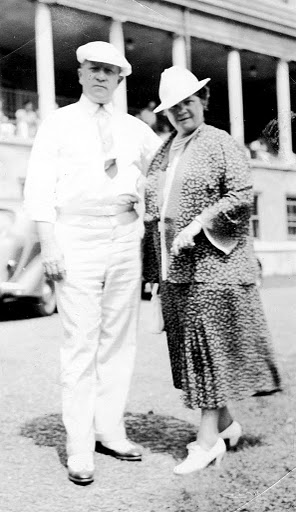
That looks like Grandma McNally on the right.
Who is the woman dressed so much like her on the left?

In Uncle Jack's box of pictures Lorraine found some pictures of people that we can't identify.
There were no notes on the photos either.

Who is this little girl?
What a beautiful building.

Maybe the same girl, same day photographed at the Queens Village house.

Who is sitting to the left of Grandpa in the anniversary photo?
This may be their 50th wedding anniversary, which would make it November, 1955.


That's Grandma on the left and Grandpa on the right, but who is in the center?